Performed, Not Manufactured: How Willy Porter’s Humans in a Room Presents a New Era of Immersive Recording
Direct-to-immersive array by Immersive Design Labs preserves Porter's artistic intent, capturing performance exactly as it happened in the studio
Minneapolis, MN, October 1, 2026 — On his recently released album Humans in a Room, Americana singer-songwriter Willy Porter set out to preserve something often lost when a performance is separated into individual parts during recording and mixing: the interaction of musicians listening and responding to one another in real time. Captured at EastWest Studios in Los Angeles and Ocean Way Nashville using Immersive Design Labs’ direct-to-immersive array and microphones, Humans in a Room triumphantly captures the quartet performing together in a single room, in real time, rather than being 'manufactured' from start to finish by modern post-production mixing techniques.

Humans in a Room began as a live recording demonstration of IDL’s 7.0.4 Immersive Capture Array at EastWest Studios for an invited audience of audio engineers and producers. After hearing the results, Porter saw how the array could support his artistic intent and decided to expand the concept into an album. The project continued with a second one-day IDL showcase at Ocean Way Nashville, which yielded enough material to complete the record. Across both sessions, the musicians, their effects and the acoustics of each room were captured together as part of the performance, preserving the spatial presentation at the source rather than constructing it afterward.
“We wanted to capture the room we were in as an instrument, and the array is really a big part of that,” Porter says. “You’re taking these really honest photographs. The mission of this record was to find this emotional honesty, but also a technical honesty that really captures the vulnerability of what’s going on musically.”
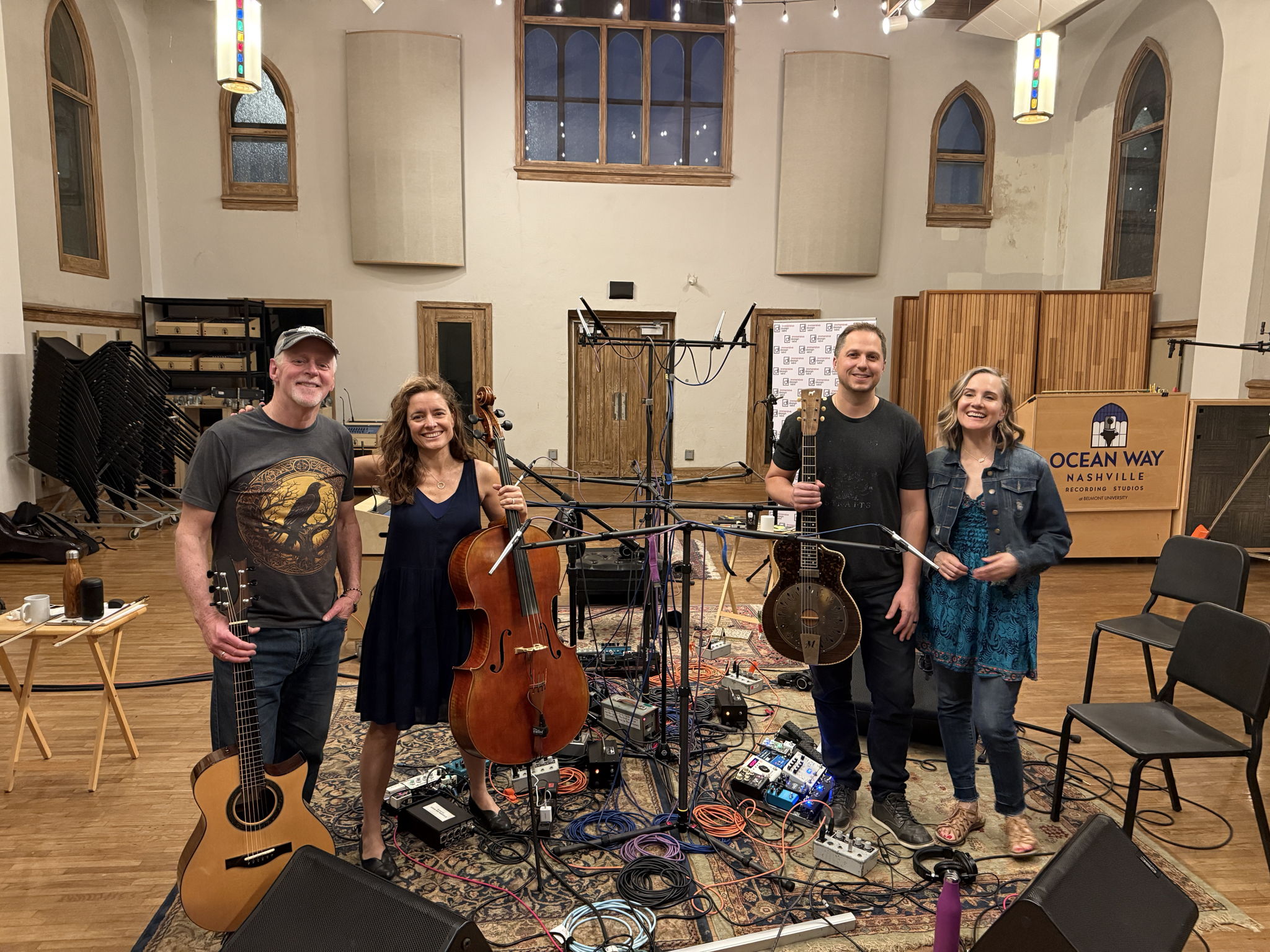
Porter performed with guitarist Ryan Pearl, cellist Mai Bloomfield, and vocalist Carmen Nickerson, with the quartet arranged in a semicircle around the array. Porter occupied the center position, with Bloomfield to his right, Pearl to his left, and Nickerson seated between Porter and Pearl. The array held 11 matched IDL-3203 microphones in seven horizontal and four elevated positions, capturing the musicians and the room from within the semicircle.
.png)
With the quartet playing live and without overdubs, the musical balance depended on their dynamics and the space they left for one another. “Recording in this way really made us, as musicians, listen to each other much more intensely and really respect each other’s space and the collective intention of serving the song,” Porter says. “If one person wipes out, the take is lost, and that’s okay. It’s really a team effort.”
To preserve the way the musicians heard and responded to one another in the room, Porter chose not to wear headphones. Bloomfield and Nickerson, positioned across the array from one another, used quiet, single-ear feeds to help with intonation, but the ensemble otherwise relied on the sound around them and their immediate interaction.
Hearing the room was essential to both how the musicians performed and what the array captured. During the EastWest setup, gobos were initially placed around the quartet to control reflections and increase separation. As the gobos began to deaden the space, however, the musicians had more difficulty hearing and reacting to one another, while less of the room reached the array. Adrian Weidmann, founder and CEO of Immersive Design Labs and executive producer of Humans in a Room, suggested reducing the isolation. The gobos were pulled back and turned so their reflective surfaces faced the quartet, allowing the musicians to hear one another without closing off the room.

Co-producer and engineer Matt Wallace suggested making the musicians’ effects part of the live capture. The guitars and cello were captured acoustically in front of the array, while fully wet guitar and cello effects were sent to QSC monitors positioned at different points behind it. The musicians controlled the amount of effect with volume or expression pedals as they played, while another monitor beneath Porter’s bench extended the low-frequency content of his guitar. “That was a real game changer,” Porter says. “It brought this ambience and reverb and all of these lush tonalities to the equation that didn’t have to be added afterward.”
“A Dog & A Leash” was the first track that let the team hear the approach come together. Each microphone channel was routed directly to its corresponding loudspeaker in a 7.0.4 monitoring system, providing one-to-one playback of what the array had captured without a Dolby renderer or object placement in between. “Nobody said a word for about five minutes,” Weidmann recalls. “We all looked at each other and realized we had captured lightning in a bottle. That set in motion the idea that this was a unique record.”
Porter describes the album’s combination of contemporary immersive technology and live ensemble performance as “new old school,” a modern recording method built around the discipline and unpredictability of a live take. “Perfect music? I can’t think of anything more boring,” he says. “I want to hear the bowing on the cello. I want to hear a flat note here and there. I want stuff that makes me feel like, wow, these people are alive. This really lives.”
That belief gives Humans in a Room its title. “The one thing that we can’t replace is humans in a room making music together,” Porter says. “We were trying to reach as high as we could in the face of our own limitations, and that’s why I celebrate that.”
Porter will support Toad the Wet Sprocket on tour this fall. Learn more about the making of Humans in a Room and access immersive listening materials at immersivedesignlabs.com/pages/humans-in-a-room.
Listen to the album and find upcoming tour dates at willyporter.com.
About Willy Porter
With a career spanning more than three decades, Willy Porter has earned acclaim for his innovative guitar work, soulful vocals, and vivid storytelling that bridges folk, rock, and blues. Humans in a Room continues his tradition of musical craftsmanship and expands it into a fully immersive sonic experience.
About Immersive Design Labs
Immersive Design Labs (IDL) is redefining the future of immersive audio by grounding its products, methodologies, techniques, and research in the core principles of sound physics and human psychoacoustics. The company’s approach merges cutting-edge technology with a deep understanding of how humans perceive sound, creating innovative solutions for the next generation of immersive audio experiences.
To learn more about Immersive Design Labs and its approach to immersive recording, visit www.immersivedesignlabs.com.

Hunter Williams


.png)